
Steve Jobs: Making Technology Feel Human
Steve Jobs’s story is often told through keynote images: the black turtleneck, the white screen, the product held up at exactly the right moment, the audience realising that a familiar category has changed shape. But the real story lives in the editing before the presentation — the decisions about what to remove, what to protect, and how to make a complicated idea feel obvious.
Jobs understood that technology has two lives. One is technical: the processor, the operating system, the materials, and the manufacturing. The other is human: the reason someone wants the object, the way it fits into a routine, and the feeling that the product belongs in their life.
The Apple I and a different kind of company
Steve Jobs was born in San Francisco in 1955 and grew up in the area that would become known as Silicon Valley. In 1976, he and Steve Wozniak co-founded Apple and began assembling the Apple I. The machine was important not only because it worked, but because Jobs saw a path from hobbyist technology to something people could encounter as a product.
That instinct shaped the company from the beginning. The goal was not simply to make powerful electronics. It was to make the relationship between a person and a computer feel more direct.
A Steve Jobs Apple founder poster carries that early chapter into an office or studio: the founder, the machine, and the belief that a computer could become part of everyday culture.
Macintosh and the power of the interface
The Macintosh introduced a wider audience to a computer built around a graphical interface and a different kind of interaction. The significance was not only the hardware. It was the invitation. A computer could be approached through windows, icons, a mouse, and a visual language that made the system less intimidating.
Jobs’s contribution was partly product judgment and partly communication. He knew that people need a reason to care before they learn the specification. The Macintosh was presented as an idea about creativity, agency, and the kind of work a computer could make possible.
The Steve Jobs Macintosh poster keeps that relationship visible: a black-and-white portrait, the early computer era, and the question of what technology is for once the novelty wears off.
Leaving Apple, building NeXT, and Pixar
Jobs left Apple in 1985 and started NeXT, a company focused on powerful computers and software for education and business. The company did not become a mass-market success in the same way Apple later would, but its technology and design thinking became important to the next chapter.
He also became the leader of Pixar, helping shape a company that used computer graphics to tell stories with a new visual language. The lesson was not limited to one industry. Whether the product was a workstation or an animated film, the same questions returned: what is the essential idea, how should the experience feel, and what can be removed without weakening it?
The return and the edit
Jobs returned to Apple in the late 1990s, when the company needed a clearer direction. The response began with subtraction. Products were reduced, the product line became easier to understand, and the company concentrated on a smaller number of experiences that could be made coherent from the inside out.
The iMac became a public signal of the change. It was colourful, approachable, and deliberately different from the beige boxes that had defined the category. The iPod then connected hardware, software, and a simple promise: carry your music with you.
The Steve Jobs Think Different poster belongs to this era of clarity. The phrase became a campaign, but the larger point was about choosing a point of view and letting the product express it.
iPhone and the product as a story
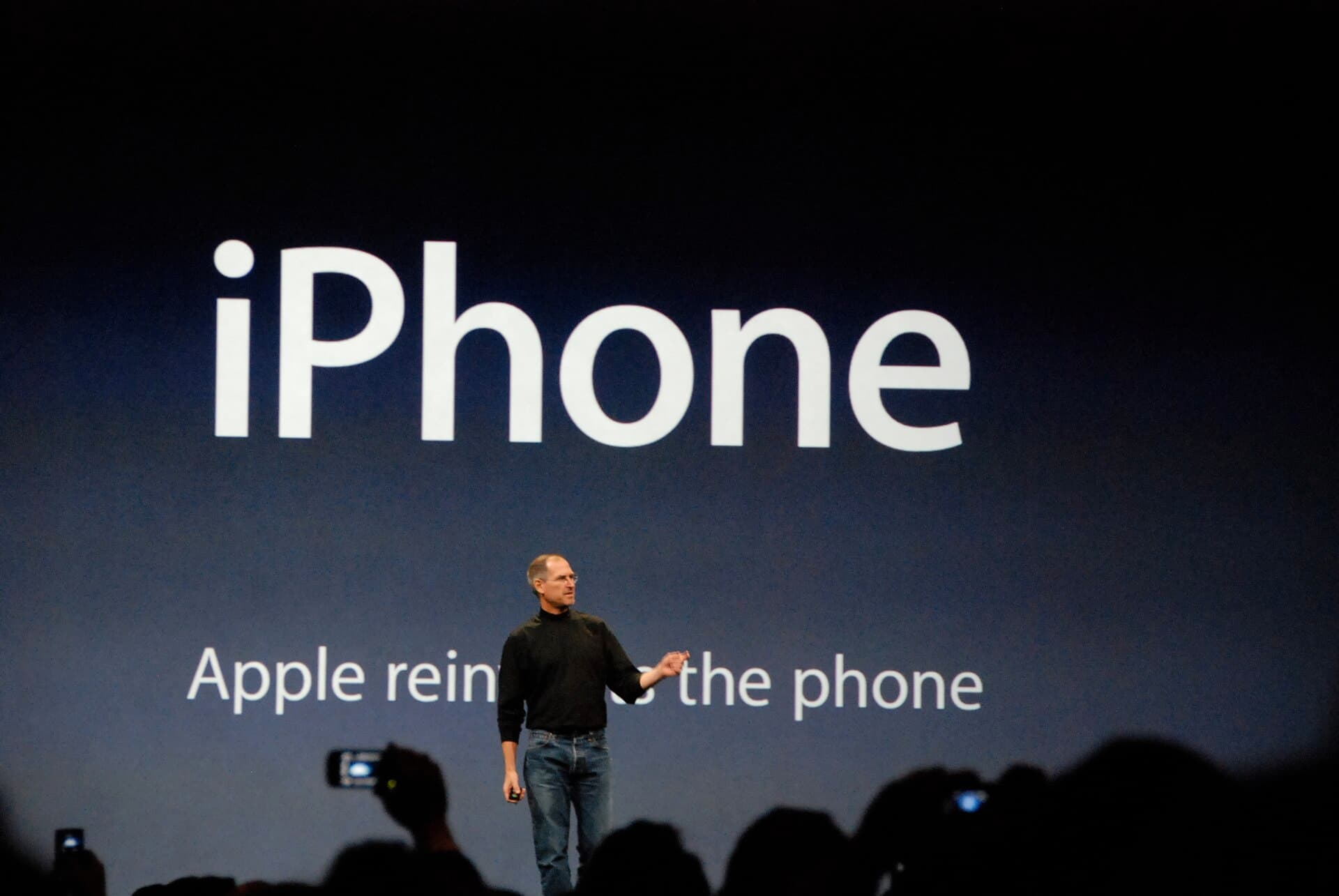
When Jobs introduced the iPhone in 2007, he did more than present a new phone. He described a combination of a phone, an iPod, and an internet communicator, then showed how the three ideas could become one object. The presentation worked because the technology was translated into a sequence of human actions: touch, scroll, listen, call, browse.
The Steve Jobs iPhone presentation poster holds onto that keynote energy: the stage, the dark background, and the moment when a product becomes a shared cultural image.
Why the Jobs archive still matters
Jobs’s legacy is not a request to imitate a keynote or repeat a slogan. It is a reminder that clarity is an active choice. Every product, room, article, or idea becomes stronger when its purpose can be felt quickly.
That is why the images remain immediate. The stage is simple, the object is small, and the message is direct. Behind that simplicity is a long process of editing — a willingness to keep asking what matters until the answer can stand on its own.
Explore the Steve Jobs collection
The story continues in the artwork. Here are a few Steve Jobs designs available from Posteryze:
- Steve Jobs Inspirational Poster
- Steve Jobs Apple Founders Poster
- Steve Jobs Think Different Poster
- Steve Jobs Macintosh Poster
Hero image: Steve Jobs presenting the original iPhone at MacWorld in 2007. Photo by Blake Patterson, Wikimedia Commons, licensed under CC BY 2.0.
This editorial story is an original summary based on the Steve Jobs Archive, Make Something Wonderful, and Steve Jobs’s Wikipedia biography.