
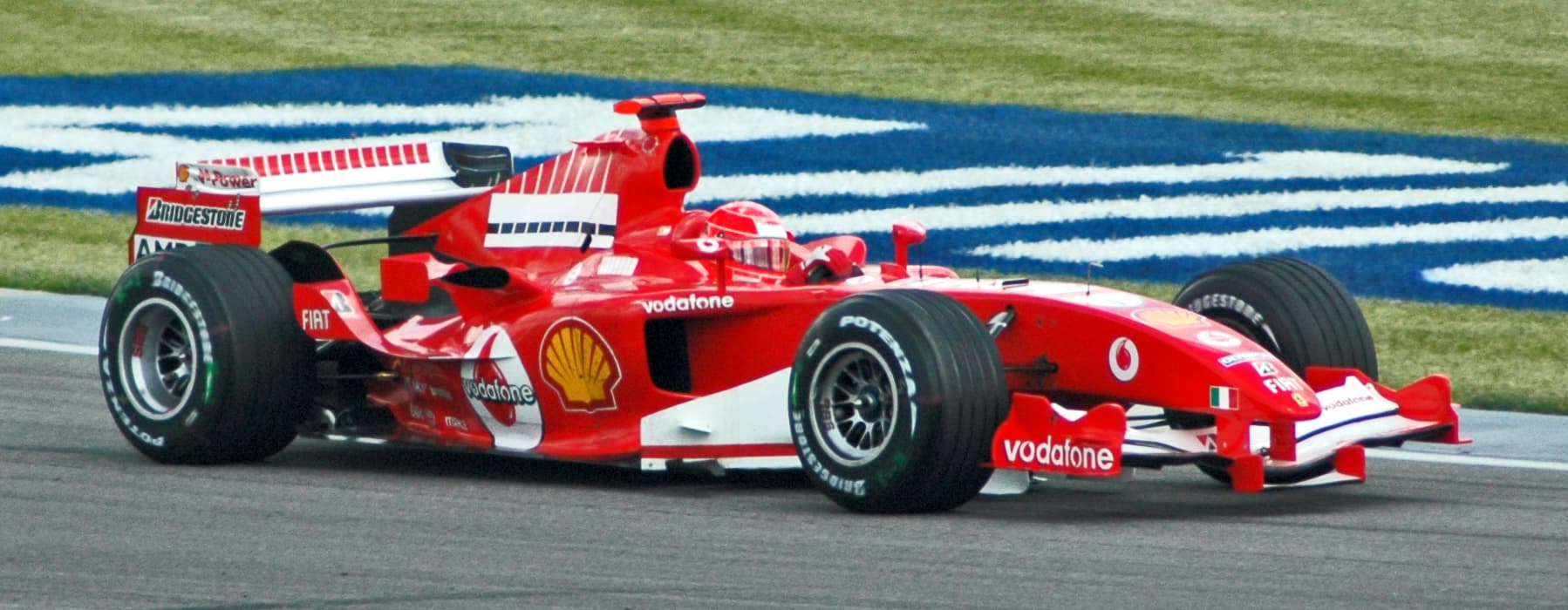
Michael Schumacher: The Ferrari Standard
Michael Schumacher’s story is often told through its biggest images: the red Ferrari, the raised fist, the helmet disappearing into the first corner, the championship celebrations that became a familiar part of the season. But the real story lives in the work behind those images — the preparation, the technical feedback, and the ability to make a fast lap feel repeatable.
From a kart track near Kerpen to seven world championships, Schumacher built a career around the idea that speed is not a single moment. It is a system of decisions that has to survive qualifying, strategy, traffic, weather, pressure, and the final lap.
Kerpen, Spa, and the arrival of a new talent
Michael Schumacher was born near Cologne, Germany, in 1969. His father ran a kart track, and the young Schumacher learned early that racing was as much about reading the surface and finding the line as it was about bravery. The karting years gave him the foundation for a style that would later look effortless in a Formula 1 car.
His Grand Prix debut came at Spa-Francorchamps in 1991. Schumacher qualified seventh for Jordan in a single weekend that immediately changed the direction of his career. Benetton signed him after that first appearance, and in 1992 he took his first Formula 1 victory — at the same circuit that had introduced him to the world.
A Michael Schumacher Formula 1 legends poster belongs to that opening chapter: the driver, the Ferrari colours, and the feeling of a career already carrying its own momentum.
Benetton and the first championships
At Benetton, Schumacher became more than a fast driver. He became the centre of a team’s development. His qualifying speed was obvious, but his influence came from the full weekend: understanding how the car behaved, communicating what it needed, and building a race plan around the conditions in front of him.
He won his first world championship in 1994 and defended it in 1995. Those titles showed the range of his approach. Schumacher could attack from the front, recover from a compromised grid position, and keep his concentration when a race became a sequence of small tactical problems.
The early titles also established a visual contrast that would define much of his legacy. The helmet was still, the car was controlled, but the performance often looked like an argument with the limits of the track.
Ferrari and the long rebuild
Schumacher joined Ferrari in 1996, when the team was still searching for the structure that could return it to the top of the championship. The first seasons brought wins and flashes of dominance, but not an immediate title. That delay became part of the story. Schumacher and Ferrari had to build the standard before they could live inside it.
The Michael Schumacher Ferrari F1 poster captures the identity of that period: the red car, the Italian team, and a driver working through the details that turn potential into a championship operation.
Ferrari’s breakthrough came in 2000. Schumacher won the world championship and ended Ferrari’s long wait for a drivers’ title. Four more championships followed from 2001 to 2004, creating one of the most dominant stretches in Formula 1 history.
Precision at full speed
What made Schumacher feel different was not simply that he was fast. It was the precision of the fast lap. The braking point arrived late but not carelessly. The car used every usable centimetre of track. The line through a corner was not a flourish; it was the shortest route to the next decision.
His technical relationship with the team mattered just as much. Schumacher could describe the behaviour of a car in a way that helped engineers move the whole package forward. The result was a partnership between driver and machine that became a model for the Ferrari era.
The Michael Schumacher starting grid poster keeps that tension in focus. Before the lights go out, everything is still possible: strategy, weather, reliability, and the first braking zone waiting to decide the tone of the race.
Monaco, Ferrari, and the image of control
Monaco became one of the natural settings for Schumacher’s visual archive. The circuit demands precision because there is no room to hide a mistake. Walls replace run-off areas, and every lap tests whether the driver can keep the car close to the limit without crossing it.
The Michael Schumacher Monaco print carries that atmosphere into a room: Ferrari red against the narrow streets, the concentration of a driver who has no spare space, and the sense that control can be more dramatic than chaos.
Why the Ferrari standard still feels immediate
Schumacher’s legacy is often measured through seven championships, 91 victories, and the records that shaped how Formula 1 understood dominance. But the deeper legacy is a working method: arrive prepared, communicate clearly, and treat every lap as a chance to remove one more source of uncertainty.
That is why the images remain so powerful. The car is unmistakable, but it is never only about the car. It is about the person inside it making the complicated look direct — a clean line, a decisive brake, and the next corner already understood.
Explore the Michael Schumacher collection
The story continues in the artwork. Here are a few Michael Schumacher designs available from Posteryze:
- Michael Schumacher Formula 1 Legends Poster
- Michael Schumacher Ferrari F1 Poster
- Michael Schumacher Starting Grid Poster
- Michael Schumacher Monaco Print
Browse all Michael Schumacher posters
Hero image: Michael Schumacher driving a Ferrari during practice at the 2005 United States Grand Prix. Photo by Dan Smith, Wikimedia Commons, licensed under CC BY-SA 2.0.
This editorial story is an original summary based on Formula 1’s Michael Schumacher Hall of Fame profile, Michael Schumacher’s Wikipedia biography, and the official Michael Schumacher website.