
Lionel Messi: From Rosario to World Champion
Lionel Messi’s story is often told through its biggest images: the Barcelona shirt, the Argentina number 10, the World Cup trophy held above his head. But the real story lives in the movement between those images — the first touch, the pause before a dribble, and the quiet decision that turns a crowded pitch into open space.
From Rosario to Barcelona, from international heartbreak to Argentina’s triumph in Qatar, Messi’s career has been shaped by a rare combination of patience and invention. He has made football feel smaller and more understandable, as if the most difficult route through a defence was visible all along.
Rosario and the first signs of something different
Lionel Andrés Messi was born in Rosario, Argentina, in 1987. He started playing football as a child and joined Newell’s Old Boys before moving to Barcelona’s academy at thirteen. The change was enormous: a new country, a new language, and a new football culture, all while Messi was still learning what his body could do.
Barcelona recognised that his talent was unusual, but the early years were still about development. Messi had to grow into the physical demands of the game while protecting the qualities that made him special. The low centre of gravity, the close control, and the ability to accelerate after a change of direction were not tricks added later. They were the foundation.
Barcelona and the making of a visual language
Messi reached Barcelona’s first team in the early 2000s and gradually became the centre of the club’s football identity. He could begin wide, move inside, drop between the lines, or arrive in the box without warning. The position changed; the logic stayed the same. Messi was always searching for the smallest gap through which the next action could pass.
The Barcelona years turned that instinct into a complete language. There were solo runs, clipped finishes, impossible free kicks, and combinations that seemed to happen at a different speed from the rest of the match. He became the club’s record scorer and one of the defining players of an era in which Barcelona’s style was studied as closely as Messi himself.
A Lionel Messi Barcelona poster carries that feeling into the room: the blue and garnet colours, the number 10, and the visual calm that often arrived just before something decisive.
The weight of Argentina
For all the success at club level, Messi’s relationship with Argentina carried a different kind of pressure. The national team was not simply another shirt. It was the place where every comparison became personal, and where the question of whether his club brilliance could become international glory followed him through every tournament.
Argentina reached the 2014 World Cup final but lost to Germany in extra time. The next years brought more disappointment, including defeats in the Copa América finals of 2015 and 2016. After the 2016 final, Messi briefly announced his international retirement, a moment that revealed how much the national team’s failures had cost him.
He returned, because the story was not finished. The 2021 Copa América victory in Brazil finally gave Messi a major senior international title and changed the emotional balance around the Argentina shirt. It was not the end of the pressure, but it made the next chapter feel possible.
Qatar and the image that completed the story
The 2022 FIFA World Cup became Messi’s defining international campaign. Argentina lost its opening match to Saudi Arabia, then rebuilt its way through the tournament with the captain at the centre of every important moment.
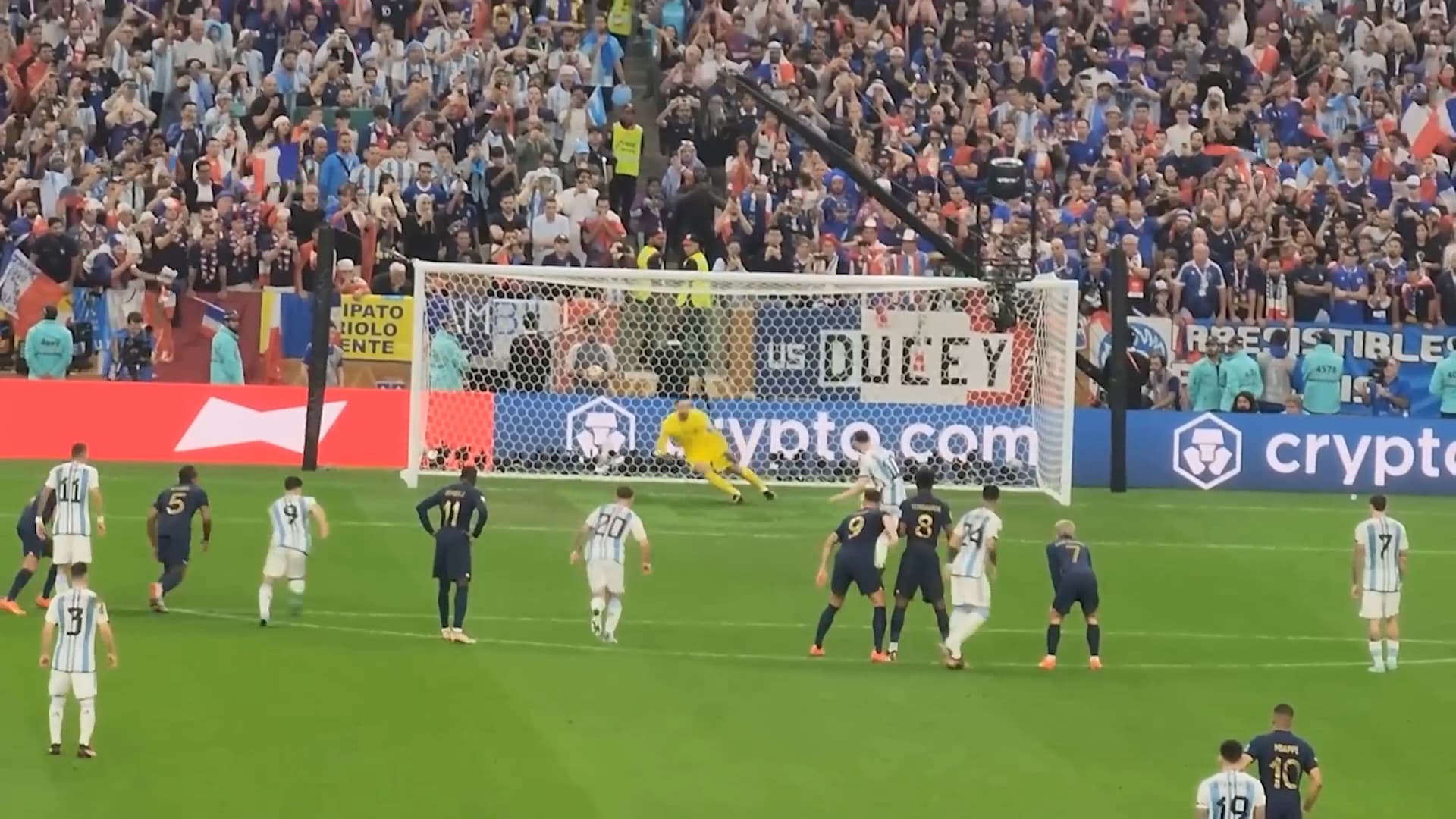
The final against France became one of football’s most dramatic matches. Messi scored twice, Argentina and France finished 3–3 after extra time, and Argentina won the penalty shootout. Messi lifted the World Cup at last, completing the one achievement that had followed him for most of his career.
The Lionel Messi World Cup poster and Argentina champions print belong to that chapter. They are not only records of a final; they hold the release of a long wait, the blue-and-white shirt, and the moment when the story’s most persistent question finally had an answer.
A new chapter in Miami
In 2023, Messi moved to Inter Miami and brought the next stage of his career to Major League Soccer. It was a different setting from Barcelona and Paris: a new league, a new city, and a club still building its identity. The move also showed a side of Messi’s career that is easy to miss when the trophy list becomes the whole story — the willingness to choose a new environment and make it meaningful.
His arrival changed the scale of attention around Inter Miami, but the football remained recognisable. The touches were still close, the passes still arrived early, and the left foot still made the final decision look inevitable. The setting had changed; the central idea had not.
The Lionel Messi El Clásico celebration poster looks back to one of the rivalry moments that defined his Barcelona era, while the Messi Barcelona captain poster captures the authority that came with becoming more than a prodigy. Together, they show the range of the archive: early electricity, established leadership, and the memory of a player who made the biggest matches feel personal.
Why Messi still feels different
Messi’s influence is not only a matter of goals or trophies. It is the way he changed the viewer’s sense of time. He could slow a move down until defenders committed, then accelerate through the space they had left. He could make a pass before the run was obvious, or finish a chance while the goalkeeper was still adjusting.
There is also a quietness to the performance. Messi has rarely needed to announce what he is about to do. The movement says enough. That is why his best moments remain so easy to recognise: a body feint, a short stride, a sudden angle, and the ball already moving toward the place everyone else has just realised exists.
His legacy is now spread across several visual worlds — Barcelona’s blue and garnet, Argentina’s sky blue and white, Paris, and Inter Miami’s pink. But the common thread is the same: a player who made control feel expressive and made imagination look repeatable.
Explore the Lionel Messi collection
The story continues in the artwork. Here are a few Lionel Messi designs available from Posteryze:
- Lionel Messi Barcelona Poster
- Lionel Messi World Cup Poster
- Lionel Messi Argentina Champions Poster
- Lionel Messi El Clásico Celebration Poster
Browse all Lionel Messi posters
Hero image: Lionel Messi taking a penalty for Argentina in the 2022 FIFA World Cup final. Image by Sebas, Wikimedia Commons, licensed under CC BY 3.0.
This editorial story is an original summary based on Lionel Messi’s Wikipedia biography, the official Inter Miami player profile, and FIFA’s Lionel Messi profile.