
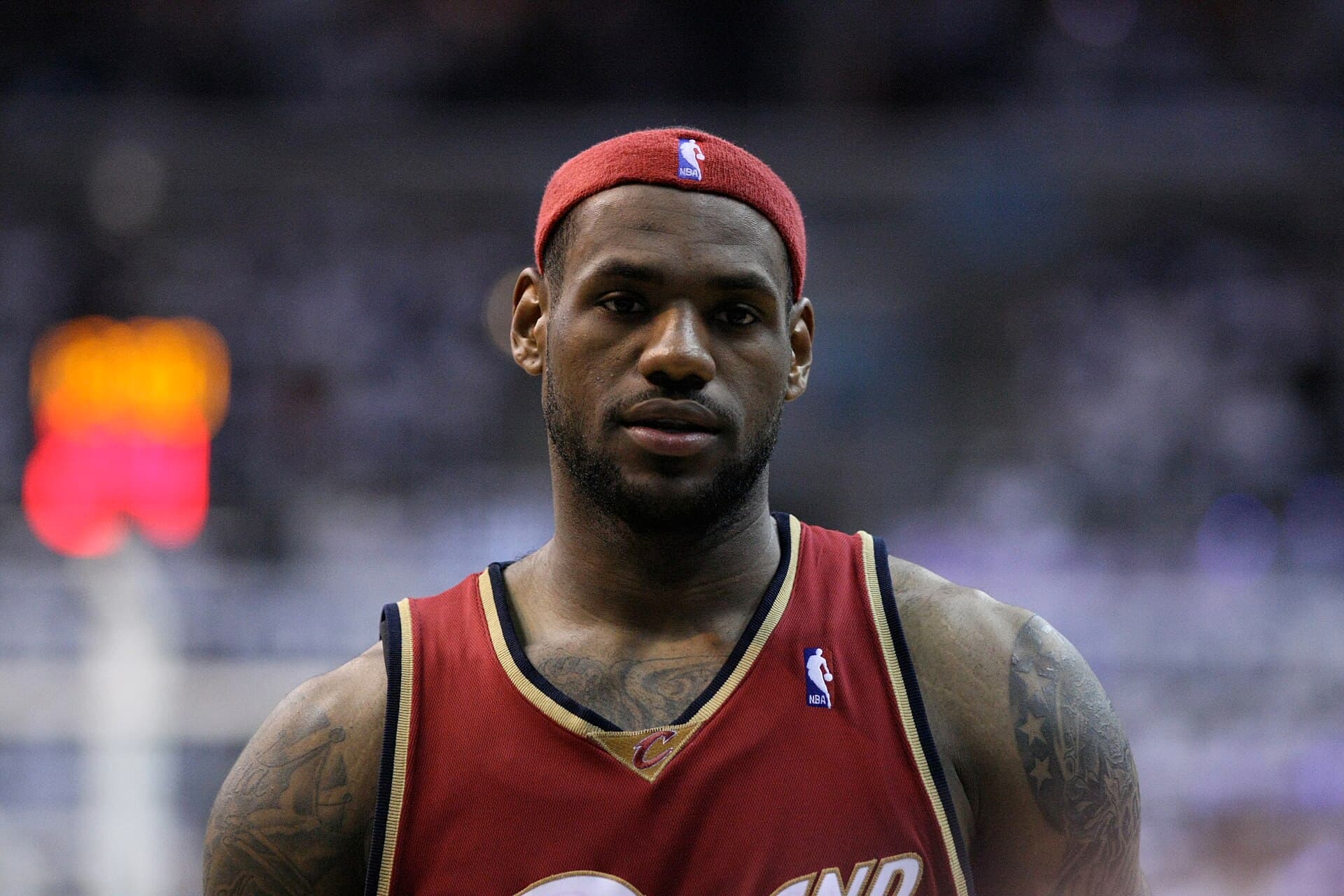
LeBron James: The King of the Complete Game
LeBron James’s story is often told through its biggest images: the chase-down block, the full-court drive, the stare after a dunk, the hands raised after a championship. But the real story lives in how many different jobs he can do in the same possession — bring the ball up, see the second defender, take the contact, and still find the open corner.
From Akron to the NBA, from Cleveland to Miami and back again, LeBron has made versatility feel like a form of power. His career is not only a record of scoring and trophies. It is a record of a player constantly expanding the responsibilities of a forward.
Akron and the arrival of “The Kid from Akron”
LeBron was born in Akron, Ohio, in 1984 and became a national basketball story at St. Vincent–St. Mary High School. Even before the NBA draft, the attention around him was unusual: he was not only a scorer, but a passer, ball-handler, rebounder, and defender with the physical tools to change the game at both ends.
The Cleveland Cavaliers selected him first overall in the 2003 NBA Draft. The expectation was enormous, but the early promise quickly became production. He won Rookie of the Year, carried Cleveland to its first NBA Finals appearance in 2007, and gave the franchise a new centre of gravity.
A LeBron James Cavaliers poster belongs to that opening chapter: the red wine and gold, the number 23, and the sense of a hometown team growing around a player who could see the whole floor.
Miami and the pressure of the decision
In 2010, LeBron moved to the Miami Heat. The decision changed the scale of the conversation around him, but it also created a new basketball challenge: could his individual force become a team structure strong enough to win at the highest level?
The answer arrived through adjustment. In Miami, LeBron became a more disciplined defender and a more efficient playmaker while continuing to attack the rim with overwhelming speed. He won championships in 2012 and 2013, earning Finals MVP in both series. The Miami years were about learning how to turn talent into a repeatable standard.
The LeBron James and Dwyane Wade poster captures that chemistry: two players moving in the same direction, with the South Beach colours and the feeling of a team built around pace and trust.
Cleveland and the promise fulfilled
LeBron returned to Cleveland in 2014, bringing the weight of the first chapter with him. The goal was clear, but the route was difficult. Golden State became the dominant opponent, and the 2015 Finals ended without a championship for Cleveland.
Then came 2016. The Cavaliers fell behind 3–1 in the Finals, fought back to force a deciding game, and won the first championship in franchise history. LeBron’s chase-down block in Game 7 remains one of the defining defensive images of the era, but the title was larger than one play. It was the completion of a promise made to a city.
The LeBron James championship poster belongs to that moment: the trophy, the relief, and the rare feeling of a hometown story reaching its exact ending.
Los Angeles and a new kind of longevity
In 2018, LeBron signed with the Los Angeles Lakers and entered another historic environment. The challenge was not to repeat Cleveland. It was to take a team with a different identity and build a new version of the career around it.
The 2019–20 season ended with a fourth championship and a fourth Finals MVP. LeBron’s game had changed again. He could still overpower a defender in transition, but he was also controlling tempo, organising the offence, and using experience as a way to make the game slower for himself and faster for everyone else.
The LeBron James Lakers dunk poster keeps that chapter in focus: the purple and gold, the lift above the rim, and the sense that athleticism can become a language of its own.
The complete game
LeBron’s legacy is often discussed through totals, but the more revealing measure is the range of situations he can solve. He can score from the post, see over a double team, defend across positions, rebound into the break, or turn a late possession into a simple pass to the player the defence forgot.
He became the NBA’s all-time leading scorer, but the points only tell part of the story. His influence is also visible in the way modern forwards are expected to handle the ball, make decisions, and create advantages for teammates. The complete game is not a list of skills. It is the ability to choose the right one in the moment.
Why LeBron still feels different
LeBron’s visual power comes from contrast. He is huge on the court, but the best play may be the pass. He can finish above the rim, but the possession often begins with patience. He carries the force of a franchise player and the awareness of a point guard.
That is why the most memorable images stay connected: Akron, Cleveland, Miami, Los Angeles, the block, the dunk, the trophy, and the next pass. Together they show a career that has lasted because it has never been only one thing.
Explore the LeBron James collection
The story continues in the artwork. Here are a few LeBron James designs available from Posteryze:
- LeBron James Championship Poster
- LeBron James Cavaliers Poster
- LeBron James Lakers Dunk Poster
- LeBron James and Dwyane Wade Poster
Browse all LeBron James posters
Hero image: LeBron James playing for the Cleveland Cavaliers during the 2008 playoffs. Photo by Keith Allison, Wikimedia Commons, licensed under CC BY-SA 2.0.
This editorial story is an original summary based on LeBron James’s NBA player bio and LeBron James’s Wikipedia biography.